2026 Midyear Clinical Hypnosis Workshops
April 24 - 27, 2026 - Live online via Zoom
Registration has closed.
Note to Registered Attendees: A Final Event Confirmation email has been sent to all registered attendees. It contains your workshop selections and the Zoom links you will need to participate, along with instructions on how to receive your CE/CME credits. If it hasn’t appeared in your main inbox, please check your other folders. If you cannot find it, please email the SCEH office.
View the Daily Schedule. Note all times are in Pacific Time (PT). Workshop details can be found below.
Please bookmark this page for any event updates.
About the Midyear Workshops Overview Who May Attend - Workshop Eligibility
Registration and Pricing ADA Time Zone Register Now
100M - Introductory Workshop 200M - Intermediate Workshop 300M Series - Advanced Workshops
SCEH Policies for Attendees & Presenters What You Will Need to Participate
CONTINUING EDUCATION Education Committee Questions SCEH Membership
About the Midyear Workshops
SCEH Midyear Clinical Hypnosis Workshops include Introductory, Intermediate and Advanced level Workshops, presented live online via Zoom. Live participation is required. SCEH Workshops are designed to empower attendees with evidence-based skills and training in the application of hypnosis for mental health, medicine, and general wellness, creating a positive effect on health worldwide. While research shows that hypnosis is effective in enhancing client/patient treatment outcomes, far too few health professionals can conduct hypnosis skillfully. Workshop attendees gain knowledge and competence, can put hypnosis to immediate use in their work, and are aided by a better understanding of the uses and limits of evidence-based hypnosis practice. Three levels of workshops are tailored to the needs of those who:
- are unfamiliar with hypnosis (Introductory Workshop)
- are newly familiar with hypnosis but need additional skills (Intermediate Workshop)
- have prior training and seek further refinement in skills or specific clinical applications (Advanced Workshops).
SCEH hypnosis training programs are of the highest teaching quality and feature experiential learning, allowing attendees to put learned concepts into immediate practice. The SCEH Midyear Workshops meet accepted Standards of Training in Clinical Hypnosis and count toward SCEH Hypnosis Certification Programs. Agenda is subject to change.
Discover what attendees have to say about SCEH events and training programs.
KEY REGISTRATION DATES
Advance registration is required. Register early for the best pricing for SCEH events.
Early bird registration ends: March 16, 2026 - 5 PM ET USA
Registration deadline: April 16, 2026 - 5 PM ET USA
Registration is closed.
Event Overview
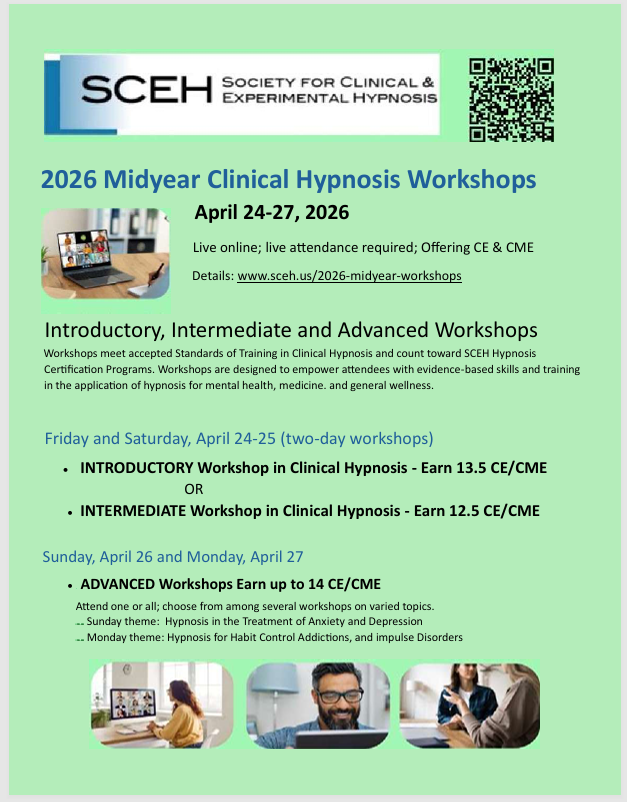
Friday and Saturday, April 24 and 25, 2026
- Introductory (Basic) Training in Clinical Hypnosis -- Earn 13.5 CE/CME
OR
- Intermediate Training in Clinical Hypnosis -- Earn 12.5 CE/CME
Sunday and Monday, April 26 and 27, 2026
- Advanced Workshops -- Earn up to 14 CE/CME
Attend one or all of the Advanced Workshop sessions -- choose from several sessions on varied topics.
-- Sunday theme - Hypnosis in the Treatment of Anxiety and Depression
-- Monday theme - Hypnosis for Habit Control, Addictions, and Impulse Disorders
Who May Attend - Workshop Eligibility
SCEH workshops are designed for physicians, psychologists, members of health care teams and other groups eligible for membership who address the physical and mental health needs of patients through clinical practice and research. While you do not need to be a member to attend, you do need to satisfy SCEH Member Eligibility Requirements.
ADA
If you require special accommodations to attend, please contact the SCEH office as soon as possible and no later than two weeks prior to the start of the event via email at [email protected].
Time Zone
Please note all event times are in PT - Pacific Time. Get help converting time zones.
Workshop Descriptions, Agendas, Presenters and Learning Objectives
Friday & Saturday, April 24-25, 2026
100M - Introductory Workshop: Foundations of Clinical Hypnosis – 13.5 CE/CME (two-day cohort)
Hypnosis is a powerful tool that allows clinicians to assist patients or clients in making meaningful changes in their physical and mental health. Hypnosis is a fruitful area of research that allows for the study of the mind and human experience, as well as the nature of hypnosis itself. In this workshop, participants will be provided with foundations in hypnosis to begin using it within their scope of practice or research.
The workshop will include large and small group experiential sessions, in addition to didactic presentations and discussion. Faculty will present the historical context and neurobiological basis of hypnosis, discuss ethical use and practice integration, and demonstrate hypnotic techniques and phenomena. Participants will leave with a fundamental understanding of hypnosis and how to facilitate it. Participants will receive resources to help them use hypnosis in research and practice. Suggestions will be provided for further training and education in hypnosis, including practice and mentorship opportunities for SCEH members.
Co-Chairs and Faculty Leads: Eric Willmarth, PhD and Barbara McCann, PhD
Additional Faculty: Linda Thomson, PhD., Louis Damis; PhD; Cassondra Jackson, PhD; Donald Moss, PhD; Nicholas Olendzki, PsyD; Scott Hoye, PsyD and David Paul Smith, PhD
About the Presenters
-
Eric Willmarth, PhD, is the Director of the Applied Psychophysiology Program and the Coordinator for the Integrative Mental Health Specialization in the College of Integrative Medicine and Health Sciences, Saybrook University, Pasadena, CA. He is a licensed clinical psychologist and has worked for over three decades in the area of chronic pain management. He is certified in biofeedback, clinical hypnosis, and pain management. He is a past president of the Society for Psychological Hypnosis (APA Div. 30), the Society for Clinical and Experimental Hypnosis, the American Society for Clinical Hypnosis, and the Michigan Society for Behavioral Medicine and Biofeedback. Beginning college as a music major, he played bassoon in the orchestra, trombone in the jazz band, and guitar in a rock band. He continues to be interested in the psychology and health benefits of music and continues to sing in his church choir. He has been married to his high school sweetheart for 50 years and has two sons and three grandsons. Life is good!
-
Barbara McCann, PhD is Professor of Psychiatry and Behavioral Sciences and Mental Health Counseling and Hypnosis Endowed Chair at the University of Washington in Seattle, Washington (USA). Her clinical psychology practice is based out of Harborview Medical Center, where she treats individuals with depression, anxiety, functional seizure disorder, and insomnia. She conducts research and scholarship in these areas. Dr. McCann teaches psychiatry residents, psychology residents, medical students, and fellows, and has received numerous teaching awards. She has published over 60 journal articles and book chapters. Dr. McCann is Immediate Past-President of the Society for Clinical and Experimental Hypnosis and Certified as an Approved Consultant by the American Society of Clinical Hypnosis. She is on the Board of Editorial Consultants for the International Journal of Clinical and Experimental Hypnosis, serves as an Advisory Editor for the American Journal of Clinical Hypnosis, and is an Associate Editor of the Encyclopedia of Hypnosis and Suggestion, published online by the International Society of Hypnosis. She is a founding member and Co-Chair of the FND Society's Hypnosis Special Interest Group.
Introductory Workshop Agenda and Learning Objectives
Download the final Agenda (PDF)
200M - Intermediate Workshop: Refining Skills and Treatment Applications – 12.5 CE/CME (two-day cohort)
(Friday & Saturday, April 24-25, 2026)
The Intermediate Workshop is taken as a cohort, and can be used toward SCEH intermediate certification requirements or simply to refresh and expand hypnotic skills. The Intermediate Workshop assists attendees in preparing for certification in hypnosis and clinical practice. The workshop features hypnotic techniques for advancing induction and deepening skills and therapeutic applications for modification of implicit memory, ego strengthening, insight, anxiety, habit disorders, and pain management.
Presenters: Louis Damis, PhD, ABPH, FASCH and Akira Otano, EdD, ABPH, FASCH
-
Louis Damis, PhD, ABPH, FASCH is a Diplomate with the American Board of Professional Psychology, a Fellow of the American Academy of Clinical Health Psychology, the Biofeedback Certification International Alliance, the American Society of Clinical Hypnosis, and the Florida Society of Clinical Hypnosis. He is an Assistant Professor at the UCF College of Medicine and an ESTI-accredited Ego State Therapist. Dr. Damis is a licensed psychologist with ASCH Consultant Status and SCEH Certification in Clinical Hypnosis. He is a Past President of ASCH as well as the Florida and Washington DC Societies of Clinical Hypnosis. He has taught hypnosis for over 25 years for the American Society of Clinical Hypnosis, the Florida Society of Clinical Hypnosis, and the Society of Clinical and Experimental Hypnosis. Dr. Damis maintains a private practice and works as an instructor, author, and consultant.
- Akira Otani, EdD, ABPH, FASCH is a psychologist in private practice at Waypoint Wellness Center in Annapolis, MD. Before joining the current practice group, he served on the graduate faculty at the Division of Education, The Johns Hopkins University, and as Senior Staff Psychologist at the University of Maryland Counseling Center at College Park.
Akira’s interest in and training in clinical hypnosis began during his doctoral internship, when he worked with Kay F. Thompson, DDS, a close friend and colleague of Milton H. Erickson, M.D. He has long been interested in meditation. In 2016, he had a 6-month sabbatical in Kobe, Japan, where he studied mindfulness meditation with a former Buddhist monk-turned-psychologist. This experience has greatly helped him synthesize hypnosis with mindfulness meditation. Akira is a Fellow and Approved Consultant of ASCH as well as a Diplomate in Psychological Hypnosis (ABPH). He has published nine books (in Japanese) and more than 70 scholarly articles and book chapters (in English and Japanese) on topics ranging from psychotherapy training and hypnosis to meditation. He is an avid book collector, meditator (more than 3,200 plus hours to date), and aficionado of spicy food.
Intermediate Agenda and Learning Objectives
Download the final Agenda (PDF)
300 Series - Advanced Workshops – Earn up to 14 CE/CME
Advanced Workshops are designed for those who have completed Introductory and Intermediate level clinical hypnosis training and wish to sharpen and refine their hypnosis knowledge and skills.
Sunday, April 26, 2026
Day’s Theme: Hypnosis in the Treatment of Anxiety and Depression
301M - Anxiety and Depression Toolbox
Carolyn Daitch, PhD
8:00 - 10:00 AM PT (11:00 AM - 1:00 PM ET) -- 2.0 CE/CME
Anxiety and depression are among the most common mental health conditions, significantly affecting functioning at work, home and in social relationships.
This workshop will present innovative and effective techniques for managing anxiety, chronic stress and depression. Hypnosis is a powerful modality that can help clients reduce apprehension, fear and worry by altering the cognitive, emotional, behavioral and physical responses that accompany anxiety. It can also be a valuable adjunct in the treatment of depression, complementing cognitive and behavioral interventions.
Workshop participants will be introduced to hypnotic interventions designed to help clients interrupt negative, irrational or obsessive thoughts; diminish worry; lessen fear of the future; and reduce restlessness, irritability, insomnia and hypochondria. Additional strategies will target sadness, hopelessness and other hallmark symptoms of depression. Mental health professionals from all backgrounds will leave this training with a broader clinical repertoire, including quick, easy to implement hypnotherapeutic techniques that can be integrated into a variety of treatment approaches.
LEARNING OBJECTIVES
- Articulate the rationale for combining hypnosis with CBT in the management of anxiety disorders and depression.
- Illustrate, demonstrate and practice specific techniques for the treatment of phobias, OCD, social anxiety disorders, post-traumatic stress disorders, and generalized anxiety disorders.
About the Presenter: Carolyn Daitch, PhD is the director of the Center for the Treatment of Anxiety Disorders in West Bloomfield, Michigan. A clinical psychologist, she is a certified and approved consultant and elected Fellow of the American Society of Clinical Hypnosis and an elected Fellow of the Michigan Psychological Association. Dr. Daitch is a frequently invited speaker worldwide and is internationally recognized for her practical and easy-to-implement interventions.
Dr. Daitch has written four books on anxiety and affect regulation, including the award-winning Affect Regulation Toolbox: Practical and Effective Hypnotic Interventions for the Over-reactive Client, which has received international acclaim and was awarded best hypnosis book by the Society of Clinical and Experimental Hypnosis in 2008. Other books include Anxiety Disorders: The Go-to Guide, Anxious in Love, and The Road to Calm Workbook. Her article on Cognitive Behavioral Therapy, Mindfulness, and Hypnosis as Treatment Methods for Generalized Anxiety Disorder was awarded best article in 2019 by the Society of Clinical Hypnosis.
10:00 - 10:15 AM PT - 15-minute break between workshops
302M - Hypnotic Interventions for the Treatment of Emetophobia and Hematophobia: A Case Review
David Reid, PsyD
10:15 - 12:15 PM PT (1:15 - 3:15 PM ET) -- 2.0 CE/CME
This Advanced Workshop will provide a brief review of the etiology of anxiety disorders and phobias. Strategic applications of clinical hypnosis for resolving symptoms associated with specific phobias including emetophobia (fear of vomiting) and fear of needles), and fear of flying will be provided to support the utilization of clinical hypnosis for treating phobias.
LEARNING OBJECTIVES
- Describe an application of clinical hypnosis to treat emetophobia.
- Describe an application of clinical hypnosis to treat hemetophobia.
About the Presenter: David B. Reid, PsyD is a Licensed Clinical Psychologist, Fellow and Approved Consultant of the American Society of Clinical Hypnosis (ASCH). Dr. Reid is an Award-Winning author of Hypnosis for Behavioral Health: Professional’s Guide to Expanding Your Practice (Springer Publishing Company), and co-author of Permanent Habit Control: Practitioners’ Guide to Using Hypnosis and Other Alternative Health Strategies (Springer Publishing Company). Dr. Reid is also the Editor-in-Chief for the American Journal of Clinical Hypnosis, and Chair of the Society for Clinical and Experimental Hypnosis (SCEH) Certification Committee. Dr. Reid received 11 Presidential awards from ASCH and SCEH for his contributions to both societies, as well as awards for his peer-reviewed published papers on clinical hypnosis (Milton H. Erickson Award, Ernest R. Hilgard Award, William S. Kroger Award). He is the recipient of the Erica Fromm Award for Excellence in Teaching from SCEH. He is an adjunct professor at Saybrook University and Past President of Division 30 (Psychological Hypnosis) of the American Psychological Association. Dr. Reid completed a postdoctoral fellowship in neuropsychology and rehabilitation psychology at the University of Virginia and continues to conduct neuropsychological evaluations at Augusta Health in Central Virginia.
12:15-1:15 PM PT – Lunch Break (60 minutes)
303M - Walking across Underground Meadows: Clinical Hypnosis with Children and Adolescents
Jane Alexandra Kessler, MA, LLP
1:15 - 3:15 PM PT (4:15 - 6 :15 ET) -- 2.0 CE/CME
Although clinical hypnosis with children and adolescents is grounded in the same principles and techniques used with adults, it requires the use of a particular kind of playfulness and imagination on the part of the therapist, as well as techniques specific to working with children and teens. Additionally, it calls for alterations to our usual approaches to consent for treatment, pre-hypnosis and post-hypnosis discussions with the patient/client, and potentially the involvement of parents. This presentation will assume a basic familiarity with clinical hypnosis so that we can jump directly into a discussion of its use in the treatment of children and teens.
LEARNING OBJECTIVES
- Contrast and describe the techniques used in hypnotherapy with children/teens with those used with adults.
- Describe a range of techniques that are specific to the use of hypnosis with children/teens.
- Examine and describe the technical and ethical issues inherent in the use of hypnosis with children/teens.
About the Presenter: Jane Alexandra Kessler, MA, LLP earned her Bachelor of Science at Brown University. She received her clinical psychology degree from the University of Michigan (Ann Arbor), completing predoctoral internships at the U. of M.'s Psychological Clinic and on the Children's Service of the Detroit Psychiatric Institute (DPI). She started her professional career as a staff psychologist and faculty member at DPI, treating severely traumatized children on the inpatient unit and teaching psychological assessment to psychology trainees. Jane also served as the director and senior psychologist at the Michigan Psychoanalytic Institute's Treatment Clinic. Additionally, she worked for the Family Division of Michigan's Sixth Circuit Court as well as Detroit's Family Court, evaluating children and families in forensic matters. For ever 20 years, Jane was a psychology professor at Madonna University (Livonia, Michigan), teaching a wide range of clinical psychology courses, and serving as the director of both the university's graduate program in clinical psychology and the campus training clinic. Currently, Jane is in private practice in Huntington Woods, Michigan, treating children, adolescents and adults, and performing forensic assessments in civil and criminal matters.
3:15 - 3:30 PM PT - 15-minute break between workshops
304M - Process-Oriented Hypnosis in Addressing Patterns and Risk Factors of Depression
Michael Yapko, PhD
3:30 - 5:30 PM PT (6:30 - 8:30 PM ET) -- 2.0 CE/CME
“You’re unique…just like everyone else.” This statement highlights a challenging conundrum: if everyone is special then is anyone special? Anyone who has been doing therapy for any significant length of time will likely have noticed that while each person is unique as an individual, their problems are often remarkably redundant: here’s yet another person making bad decisions that hurt them, another couple suffering in a distressed and depressing marriage, another person feeling unhappy with their life, and so on. Is the problem in them? Or is it in their process, i.e., the steps they follow leading to distress? By asking ‘how’ questions rather than ‘why,” we can more readily identify unhelpful processes and know where to intervene. In this workshop, I’ll describe how a general approach to hypnosis can be used to interrupt some of the specific key patterns of cognition and perception that can give rise to and maintain depression.
When people follow ineffective sequences, identifiable steps that lead them down a symptom-producing path of experience, anyone following those same steps will end up in the same psychological place. Individual differences matter less: it no longer matters how many academic degrees they might have, or what their job is, or what they like to do on their days off. For as long as they continue to do whatever they do (cognitively, behaviorally, emotionally, interpersonally, etc.) in the same problematic way, the unfortunate outcome can be quite predictable. The problem is not in them. Rather, it’s in their process.
Based on Dr. Yapko’s book, Process-Oriented Hypnosis: Focusing on the Forest, Not the Trees, the advantages of a macro-view of people’s problems will be described as a complement to the more typical micro-views clinicians focus upon. The Society for Clinical and Experimental Hypnosis gave this book its esteemed Arthur Shapiro Award for being the “best book on hypnosis in 2021.”
LEARNING OBJECTIVES
- Describe and discuss the role of over-general cognitive style in depression and hypnosis treatment response.
- Demonstrate how general language in hypnosis can generate specific effects in the listener.
- List and describe the key components of a "process-oriented hypnosis."
- Provide a structured practice session with a goal-oriented process-oriented hypnosis strategy.
About the Presenter: Michael D. Yapko, PhD is a clinical psychologist residing near San Diego, California. He is internationally recognized for his groundbreaking work in applying clinical hypnosis in outcome-focused psychotherapy, especially in the active non-pharmacological treatment of depression. He has been invited to present his innovative ideas and methods to colleagues in more than 30 countries across six continents, and all over the United States. His highly practical YouTube lecture on “How to Recover from Depression” has now been viewed more than 5.5 million times.
Dr. Yapko is the author of 16 books, three edited books, and nearly 100 journal articles and book chapters. His most recent book for professionals is the just-released updated 6th edition of his classic hypnosis textbook, Trancework. He also wrote Process-Oriented Hypnosis: Focusing on the Forest, Not the Trees and has served as Guest Editor for special issues on “Hypnosis and Treating Depression” of the International Journal of Clinical and Experimental Hypnosis and the American Journal of Clinical Hypnosis. His popular general audience books include Keys to Unlocking Depression, Depression is Contagious and Breaking the Patterns of Depression. His works have been translated into 10 languages. Dr. Yapko is also the developer of the popular digital hypnotherapy mental health app called Claria in association with the digital therapeutic company, Mindset Health (www.mindsethealth.com). Available 24/7, the app features a dozen clinical hypnosis sessions aimed at interrupting common patterns underlying depression and anxiety. Dr. Yapko was honored to receive the “Living Treasure Award” from SCEH in 2024. More information about Dr. Yapko’s work is available on his website: www.yapko.com.
Monday, April 27, 2026
Day’s theme: Hypnosis for Habit Control, Addictions, and Impulse Disorders
305M - Hypnosis for Habit Control, Addictions, and Impulse Disorders
Ronald J. Pekala, PhD
8:30 - 10:30 AM Pacific (11:30 AM - 1:30 PM ET) -- 2.0 CE/CME
This workshop will present a self-hypnosis relapse prevention training model, validated by empirical research, and its use with a substance abuse population, combining the transtheoretical perspective to addiction with counterconditioning and relapse prevention models. It will describe how to use standardized self-hypnosis protocols to help reduce and control the triggers and affective states associated with substance abuse relapse. The research on using self-hypnosis training to modify affective state and help control the triggers associated with relapse will be reviewed. Self-hypnosis protocols associated with reducing anxiety, anger, and negative affect; increasing self-esteem and serenity; and fostering relapse prevention will be discussed.
LEARNING OBJECTIVES
- Enumerate the relationships among self-esteem, serenity, anger/impulsivity, and associated variables within a substance abuse populations.
- Describe and review a self-hypnosis relapse prevention approach using standardized self-hypnosis protocols to help reduce and control the triggers and affective states associated with relapse.
About the Presenter: Ron Pekala, PhD is in Private Practice in West Chester, PA. He is a Fellow of both the American Psychological Association (APA) and the Society for Clinical and Experimental Hypnosis (SCEH). Dr. Pekala is the author of over 80 professional publications, numerous national presentations, and one book: “Quantifying consciousness: An empirical approach” (1991). He is the author of the Phenomenology of Consciousness Inventory (PCI), a self-report questionnaire that is used to quantify (altered) states of consciousness, including hypnosis. The PCI has been translated into 14 languages across the planet. Research on the PCI and the PCI-HAP (hypnotic assessment procedure) has generated three Milton H. Erickson awards and one Clark Hull award from the American Society of Clinical Hypnosis (ASCH) for “scientific excellence in writing on clinical/experimental hypnosis” over the last 25 years.
10:30 - 10:45 AM PT - 15-minute break between workshops
306M - Hypnotically Enhanced Addictions Treatment (HEAT):
Strategies for Working with Alcoholism, Drug Abuse, Gambling, Smoking-Cessation, and Weight Loss
Joseph Tramontana, PhD
10:45 - 12:45 PM Pacific (1:45 - 3:45 PM ET) -- 2.0 CE/CME
Dr.. Joseph Tramontana initially developed a hypnotic approach for smoke-stopping and weight loss and then extended the model for the hypnotic treatment of other addictive behavior. This workshop introduces a hypnotic treatment approach for alcoholism, drug dependency, and gambling behavior. The approach was published in the 2009 book, Hypnotically Enhanced Treatment of Addictions. Hypnosis can greatly increase the effectiveness of treatment of addictive and impulsive behavior.
The present workshop will introduce a treatment model, effective interventions, and case narratives illustrating the application with alcoholics, drug-dependent individuals, and gamblers. In addition, the presenter will provide short summaries of a similar hypnotic approach with smoking-cessation and weight-management. He will also describe the development of attractive treatment “packages” for marketing hypnotic treatment of addictive behavior.
LEARNING OBJECTIVES
- Describe how to utilize one hypnotic technique with patients suffering with addictions
- Craft a script and strategy to address a variety of addictive behaviors
About the Presenter: A New Orleans native, Dr. Tramontana received his B.A. in psychology from L.S.U.N.O., and his MA and PhD in clinical psychology from the University of Mississippi. While he considers himself primarily a psychotherapist, he studied and became certified in Clinical Hypnosis and sees hypnosis as a therapeutic tool to help his clients. He has offices in Baton Rouge and New Orleans, LA. Dr. Tramontana is a Fellow and recent Past-President of the American Society of Clinical Hypnosis and has published three books and several peer-reviewed articles on using hypnosis for a variety of clinical applications. He has presented internationally, most recently at the World Congress of Psychotherapy in Vienna, Austria in August 2025.
“Dr. T“, as his clients call him, was the Louisiana Psychological Association President in 2014 and in 2013 received the LPA’s Distinguished Psychologist Award. He considers his greatest accomplishment the rearing of his two children and now has seven grandchildren and one great grandchild. His current leisure activities (since he quit running) are fine dining, watching sports, and owning shares in several racehorses.
12:45 - 1:45 PM Pacific Time - Lunch Break (60 minutes)
307M - Hypnosis, Motivational Interviewing, and Zen for the Addiction
1:45 - 3:45 PM Pacific (4:45 - 6 :45 PM ET) -- 2.0 CE/CME
David Patterson, PhD, ABPP
This two-hour workshop will focus on combining hypnosis with two empirically supported modalities for facilitating treatment for addiction. The first hour will provide a brief recap of motivational interviewing (MI) for addiction issues, with the understanding that participants will know the basics of this approach. We will then focus on how hypnosis can be used to enhance the effects of MI. For example, we will illustrate that cognitions reflecting motivation for change can be identified in a therapeutic interview and then reinforced in a session of hypnosis.
The second hour will begin by describing a model for integrating meditation into addiction treatment and psychotherapy. We will discuss Zen Buddhist notions of dualism and the illusion of a “self”. We will then focus on how patients can be taught a brief version of meditation that they can rehearse in the session. The argument will be that it is best if patients embark on a sophisticated discipline of meditation; however, given that there is no guarantee they will do so, we argue on the value of beginning at a simple level. We will strengthen the meditation process with hypnosis. Ultimately, we will demonstrate that returning to the present moment though meditation can mitigate the cravings that come with addiction.
LEARNING OBJECTIVES
- Describe the basic approaches of motivational interviewing amplified by hypnosis for eliciting addictive behavior change.
- Articulate the neuroscience that underlies meditation and how hypnosis can facilitate this discipline for relapse prevention.
About the Presenter: David R Patterson, PhD, ABPP, is an emeritus professor of psychology in the Departments of Rehabilitation Medicine, Surgery and Psychology at the University of Washington School of Medicine. Dr. Patterson’s current interests are in psychological approaches to the reducing and managing pain, particularly through hypnosis, immersive virtual reality and Eastern concepts such as mindfulness and Zen Buddhism. He remains a strong advocate of providing interventions for people in pain, particularly after trauma, and has conducted several studies using pharmacology, as well as psychological alternatives. Dr. Patterson has over 200 peer-reviewed publications, chapters, monographs, and book chapters on topics such as pain control and adjustment to burn injuries and trauma. He has co-directed the bioethics committee in his hospital and published in the New England Journal of Medicine on topics related to bioethics. He was funded from 1989 to 2020 by the National Institutes of Health to conduct randomized controlled trials on treating burn pain and trauma pain. He has developed internship and postdoctoral training programs and has mentored hundreds of students. He has given keynote lectures and clinical workshops in dozens of countries; His work has been featured on both national and international news outlets on numerous occasions over the past 30 years. Dr Patterson’s book with Elena Mendoza entitled Clinical Hypnosis for Pain Control was published in 2024.
Return to top of page
SCEH Policies for Attendees & Presenters
All Presenters and Attendees are asked to familiarize themselves with SCEH Policies.
What You Will Need to Participate
All registered participants will be sent an email event confirmation the day before the Midyear Workshops begin. To make sure you get it, please whitelist our email addresses to ensure event-related communications arrive in your in box!
This event confirmation email will contain:
- Any meeting link(s) you need to log in to your workshop(s) via Zoom
- Continuing Education information on how to obtain your CE/CME credits or any attendance documentation you may require.
Technical Support: Please test your online connectivity and audio/video settings in Zoom well in advance of the event date.
CONTINUING EDUCATION
SCEH 2026 Midyear Clinical Hypnosis Workshops
April 24- 27, 2026
Online
Joint Accreditation Statement
In support of improving patient care, this activity has been planned and implemented by Amedco LLC and Society for Clinical & Experimental Hypnosis. Amedco LLC is jointly accredited by the Accreditation Council for Continuing Medical Education (ACCME), the Accreditation Council for Pharmacy Education (ACPE), and the American Nurses Credentialing Center (ANCC), to provide continuing education for the healthcare team.
Amedco Joint Accreditation #4008163.
Physicians (ACCME) Credit Designation
Amedco LLC designates this live activity for a maximum of 40.00 AMA PRA Category 1 CreditsTM. Physicians should claim only the credit commensurate with the extent of their participation in the activity.
- Intro Workshop 13.5 hours
- Intermediate Workshop 12.5 hours
- Advanced Workshop – each is 2 hours for 7 sessions for a maximum of 14 hours
Psychologists (APA) Credit Designation

This course is co-sponsored by Amedco and Society for Clinical & Experimental Hypnosis. Amedco is approved by the American Psychological Association to sponsor continuing education for psychologists. Amedco maintains responsibility for this program and its content. 40.00 hours.
- Intro Workshop 13.5 hours
- Intermediate Workshop 12.5 hours
- Advanced Workshop – each is 2 hours for 7 sessions for a maximum of 14 hours
The following state boards accept courses from APA providers for Counselors: AK, AL, AR, AZ, CA, CO, CT, DC, DE, FL, GA, HI, IA, ID, IL, IN, KS, KY, MD, ME, MO, NC, ND, NH, NE, NJ, NM, NV, OK*, OR, PA, RI, SC, SD, TN, TX, UT, VA, WI, WY
MI: No CE requirements.
*OK: Accepts APA credit for live, in-person activities but not for ethics and/or online courses.
The following state boards accept courses from APA providers for MFTs: AK, AR, AZ, CA, CO, CT, DE, FL, GA, IA, ID, IN, KS, MD, ME, MO, NE, NC, NH, NJ, NM, NV, OK*, OR, PA, RI, SC, SD, TN, TX, UT, VA, WA, WI, WY
AL MFTs: Credits authorized by NBCC or any other state licensing agency will be accepted.
MA MFTs: Participants can self-submit courses not approved by the MAMFT board for review.
The following state boards accept courses from APA providers for Addictions Professionals: AK, AR, CO, CT, DC, DE, GA, IA, IN, KS, LA, MD, MO, MT, NC, ND, NE, NJ, NM, NY (held outside NY ONLY), OK*, OR, SC, UT, WA, WI, WY
The following state boards accept courses from APA providers for Social Workers: AK, AR, AZ, CA, CO, DE, FL, GA, ID, IN, KY, ME, MN, MO, NE, NH, NM, OR, PA, VT, WI, WY
Social Workers (ASWB) Credit Designation
As a Jointly Accredited Organization, Amedco is approved to offer social work continuing education by the Association of Social Work Boards (ASWB) Approved Continuing Education (ACE) program. Organizations, not individual courses, are approved under this program. State and provincial regulatory boards have the final authority to determine whether an individual course may be accepted for continuing education credit. Amedco maintains responsibility for this course. Social Workers completing this course receive 40.00 GENERAL continuing education credits.
- Intro Workshop 13.5 hours
- Intermediate Workshop 12.5 hours
- Advanced Workshop – each is 2 hours for 7 sessions for a maximum of 14 hours
The following state boards accept courses offering ASWB ACE credit for Social Workers: AK, AL, AR, AZ, CA, CO, CT, DC, DE, FL, GA, HI, ID, IL, IN, IA, KS, KY, LA, ME, MD, MA, MI, MN, MS, MO, MT, NC, ND, NE, NH, NM, NV, OH, OK*, OR, PA, RI, SC, SD, TN, TX, UT, VT, VA, WA, WI, WV*, WY
*OK: Accepts ASWB ACE for live, in-person activities but not for ethics and/or online courses.
*WV: Accepts ASWB ACE unless activity is held live in West Virginia.
The following state boards accept courses offering ASWB ACE credit for Counselors: AK, AR, AZ, CA, CO, CT, DC, FL, GA, IA, ID, IL, IN, KS, MA, MD, ME, MO, ND, NE, NM, NH, NV, OK*, OR, PA, TN, TX, UT, VA, WI, WY
AL: Activities without NBCC approval may be approved upon receipt of documentation prior to the activity BEFORE the event. No approvals afterward by the board.
MI: No CE requirement
The following state boards accept courses offering ASWB ACE credit for MFTs: AK, AR, AZ, CA, CO, FL, IA, ID, IN, KS, MD, ME, MO, NC, NE, NH, NM, NV, OK*, OR, PA, RI, TN, TX, UT, VA, WI, WY
AL MFTs: Credits authorized by NBCC or any other state licensing agency will be accepted.
MA MFTs: Participants can self-submit courses not approved by the MAMFT board for review.
MI: No CE requirement.
The following state boards accept ASWB ACE credit for Addictions Professionals: AK, CA, CO, CT, GA, IA, IN, KS, LA, MO, MT, ND, NM, NV, OK, OR, SC, WA, WI, WV, WY
New York Board for Social Workers (NY SW)
Amedco SW CPE is recognized by the New York State Education Department’s State Board for Social Work as an approved provider of continuing education for licensed social workers #0115. 40.00 hours.
- Intro Workshop 13.5 hours
- Intermediate Workshop 12.5 hours
- Advanced Workshop – each is 2 hours for 7 sessions for a maximum of 14 hours
New York Board for Mental Health Counselors (NY MHC)
Amedco is recognized by the New York State Education Department’s State Board for Mental Health Practitioners as an approved provider of continuing education for licensed mental health counselors. #MHC-0061. 40.00 hours.
- Intro Workshop 13.5 hours
- Intermediate Workshop 12.5 hours
- Advanced Workshop – each is 2 hours for 7 sessions for a maximum of 14 hours
New York Board for Marriage & Family Therapists (NY MFT)
Amedco is recognized by the New York State Education Department’s State Board for Mental Health Practitioners as an approved provider of continuing education for licensed marriage and family therapists. #MFT-0032. 40.00 hours.
- Intro Workshop 13.5 hours
- Intermediate Workshop 12.5 hours
- Advanced Workshop – each is 2 hours for 7 sessions for a maximum of 14 hours
New York Board for Psychology (NY PSY)
Amedco is recognized by the New York State Education Department’s State Board for Psychology as an approved provider of continuing education for licensed psychologists #PSY-0031. 40.00 hours.
- Intro Workshop 13.5 hours
- Intermediate Workshop 12.5 hours
- Advanced Workshop – each is 2 hours for 7 sessions for a maximum of 14 hours
Return to top of page
Registration and Pricing
- Registration will open in January.
- Member Discount: SCEH Members received discounted registration pricing as shown below.
- Continuing Education -- Both CE and CME are available. SCEH will offer both CE (for psychology and related fields) and CME (for physicians), included in the registration price. Due to the increased costs of offering CME, please note there is a registration price differential for CME. Please select the registration category that meets your needs.
- Obtaining CE documentation: Please refer to the Continuing Education section for details on the continuing education credits offered. To obtain your credits, you will need to complete the required online form that will be provided to all attendees during the event.
Important Notes about Membership Status
If you wish to join the Society and receive member pricing, please be sure to complete a membership application BEFORE you register. Your application will be reviewed, and once accepted, you will be able to register as a member for our events. Please allow 2-3 weeks for review and processing. See membership details and how to join.
If you are not sure you are a current member in good standing, log in to your account to display your status or email the SCEH office. Thank you.
Introductory (100M) or Intermediate Workshop (200M) Workshops -- offered concurrently. (You may attend one or the other.)
Pricing Category |
Early bird** |
Regular |
CME
Early bird ** |
CME
Regular |
| Member |
$230 |
$280 |
$330 |
$380 |
| Non-member |
$300 |
$350 |
$400 |
$450 |
| Student member |
$110 |
$140 |
$210 |
$240
|
| Student non-member |
$130 |
$160 |
$230 |
$260 |
Advanced Workshops (300M series) - priced per workshop - Choose to attend all or the topics of your choosing.
Pricing Category |
Early bird** |
Regular |
CME
Early bird ** |
CME
Regular |
| Member |
$72 |
$102 |
$172 |
$202 |
| Non-member |
$96 |
$126 |
$196 |
$226 |
| Student member |
$36 |
$66 |
$136 |
$166 |
| Student non-member |
$48 |
$78 |
$148 |
$178 |
Cancellations
Cancellations received on or before March 16 will be issued a refund, minus a $75 processing fee. Sorry, no refunds will be made after March 16. Exceptions will only be granted due to death of participant or immediate family member, severe illness/injury of participant or immediate family member, or the inability of participant to travel due to legal or governmental restrictions/obligations, and will require written notification and appropriate documentation. Registration fees are not transferable to another workshop.
Check Payments
Your registration is not confirmed until payment is received. If paying by check, please mail no later than two weeks prior to event. Make checks payable to: Society for Clinical and Experimental Hypnosis and mail to the address on the bottom of the page. Your registration is not confirmed until payment is received.
Education Committee
SCEH wishes to thank the Education Committee for their work in planning this event.
Chair: Don Moss, PhD
Members: Ilyse Spertus, PhD; Elizabeth G. Walsh, PhD; Betsy Gaines, PsyD; Rebecca Cherry, MD, MPH; Samuel Lurie, MEd, MSW, LICSW, Anne Doherty Johnson, Executive Director
Questions
Email us at [email protected].
About SCEH
As its mission, SCEH exists to promote excellence and progress in scientifically based hypnosis research, education, and clinical practice. The Society’s goal is to grow understanding and clinical applications of hypnosis now and in the future. SCEH boasts a rich history in hypnosis training and research, and each year presents its Annual Workshops and Scientific Session. As the voice of professional hypnosis, SCEH provides benefits that include education, the International Journal of Clinical Hypnosis, a mentor program and the ability to network with leaders in the hypnosis community.
Return to top of page
2026 Midyear Clinical Hypnosis Workshops
April 24-27, 2026 - live online via Zoom
Flyer
return to top
Earn continuing education and continuing medical education credits for certification, credentialing and professional development.
#HypnosisWorkshops #ClinicalHypnosis #ClinicalHypnosisTraining #HypnosisTraining #CE #CME
|